Updated 1 November 2026: the CPU pair in the method paragraph was corrected (it named Sandy Bridge and Ivy Bridge).
Intel just released its new Haswell server processor line (Xeon E5 v3 series), promising significant performance gains over previous-generation Ivy-Bridge processors. In this post, we will compare the two generations for a popular financial application – a Monte-Carlo LIBOR Swaption Porfolio pricer.
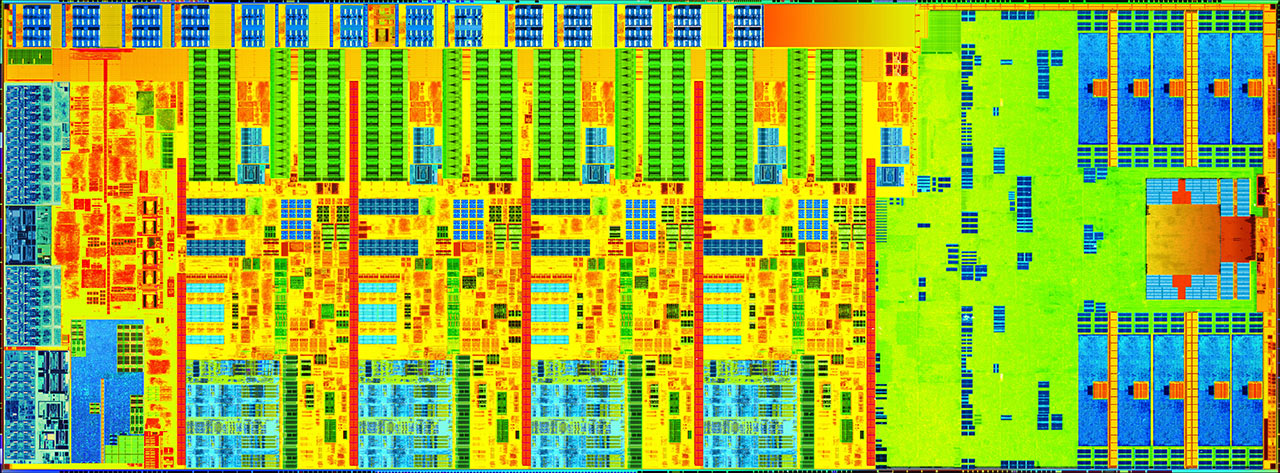
Haswell Processor Die
Intel Haswell Processor Generation
From a hardware perspective, the main changes between the two processor generations are the new AVX-2 instructions (including a fused multiply-add instruction), higher memory and cache bandwidths, and more processor cores. The table below shows a comparison of the hardware specs of the Ivy-Bridge and Haswell processors that are used further below for the benchmark:
| Ivy-Bridge (Xeon E5-2697 v2) |
Haswell (Xeon E5-2697 v3) |
|
| Cores | 12 | 14 |
| Logical Cores | 24 (HT) | 28 (HT) |
| Frequency | 2.70 GHz | 2.60 GHz |
| Cache | 30 MB | 35 MB |
| Max TDP | 130 W | 145 W |
| Max Memory Bandwidth | 59.7 GB/s | 68 GB/s |
| Instruction Set Extensions | AVX | AVX 2.0 |
Test Application: Monte-Carlo LIBOR Swaption Portfolio Pricing
Details of this algorithm have been previously described. For convenience, we briefly summarise it below:
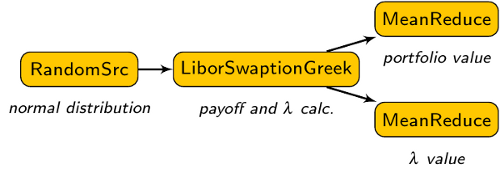
A Monte-Carlo simulation is used to price a portfolio of LIBOR swaptions. Thousands of possible future development paths for the LIBOR interest rate are simulated using normally-distributed random numbers. For each of these Monte-Carlo paths, the value of the swaption portfolio is computed by applying a portfolio payoff function. The equations for computing the LIBOR rates and payoff are given in Prof. Mike Giles’ notes. Furthermore, the sensitivity of the portfolio value with respect to changes in the underlying interest rate is computed using an adjoint method. This sensitivity is a Greek, called λ, and its computation is detailed in the paper Monte Carlo evaluation of sensitivities in computational finance. Both the final portfolio value and the λ value are obtained by computing the mean of all per-path values. The algorithm is illustrated in the following dataflow graph:
Benchmark Setup
We ran the same application, on both the Intel Ivy-Bridge and Haswell server CPUs and compare their performance. The test systems have 2 CPUs each, using the Xeons specified in the overview above. The following configuration was used:
- CPU: 2 sockets, Ivy-Bridge (Xeon E5-2697 v2) & Haswell (Xeon E5-2697 v3)
- HT: Hyper-threading enabled
- OS: RedHat Enterprise Linux 6 (64bit)
- RAM: 64GB
- Development Tools: Xcelerit SDK 3.0.0a / ICC 15.0
Performance
We measured the computation times of an optimized parallel version of the Monte-Carlo LIBOR swaption portfolio pricer. It is executed on both processor configurations, and the application performance is compared. Note that the execution time of the full application is measured, including data transfers, random number generation, and reduction.
The table below shows the speedups for different numbers of paths, comparing the Haswell processor to the Ivy-Bridge processor:
| Paths | Speedup Haswell vs. Ivy-Bridge (single precision) | Speedup Haswell vs. Ivy-Bridge (double precision) |
| 64K | 2.42× | 1.63× |
| 128K | 2.34× | 1.47× |
| 256K | 2.26× | 1.41× |
| 512K | 2.36× | 1.50× |
| 1,024K | 2.25× | 1.39× |
As can be seen, the Haswell processor gains significantly compared to the Ivy-Bridge, reaching 2.42× speedup in single precision and 1.63× in double. This is in line with the increase in the number of cores from 12 to 14 per chip, and the new fused multiply-add instruction. Many financial applications can benefit significantly from this instruction as multiplications followed by additions are very common. In single precision, a key Ivy-Bridge performance limiter of the test application is the cache bandwidth. The higher bandwidth of Haswell overcomes this limitation, explaining the high single-precision speedups.