In our previous blog post, we have seen that Haswell (Xeon E5 v3 series) achieves a significant performance boost compared to the previous generation Ivy Bridge processor (Xeon E5 v2 series). But let’s see how its performance compares to Intel’s flagship accelerator processor, the Xeon Phi, for a popular application in computational finance.
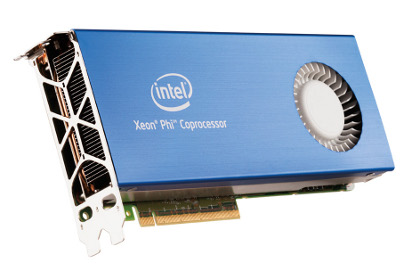
Intel Xeon Phi 7120P
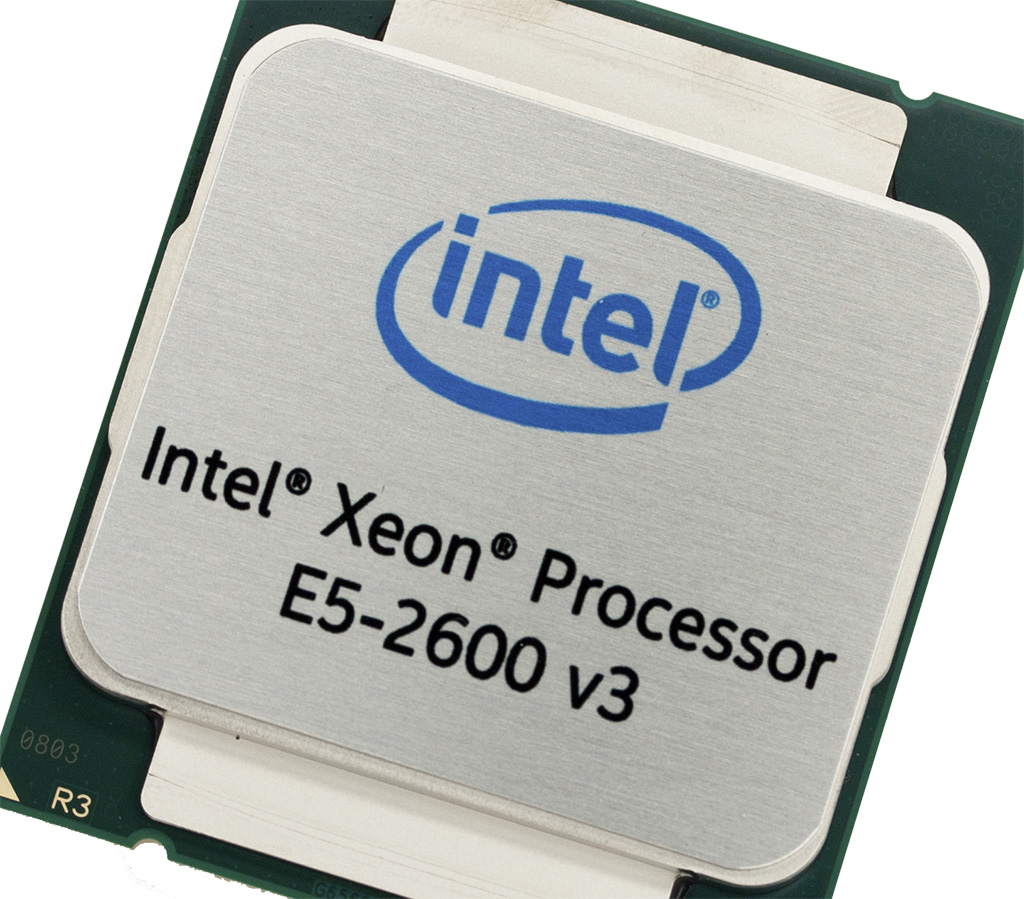
Intel Xeon E5 v3 (aka Haswell)
Hardware Specifications and Algorithm Suitability
The Xeon Phi 7120P is an x86 architecture many-core processor that has 61 cores with 4× hyperthreading, i.e., 244 logical cores. It comes as a PCIe-16× extension card, which runs it’s own Linux operating system and can be accessed by the host system either as a separate system or via offloading sections of the code to the co-processor. The Haswell processor generation, compared to Ivy-Bridge, features the new AVX-2 instructions (including a fused multiply-add instruction), higher memory and cache bandwidths, and more processor cores. A comparison of the processor specs is given in the table below:
| Xeon Phi (Xeon Phi 7120P) |
Haswell (Xeon E5-2697 v3) |
|
| Cores | 61 | 14 |
| Logical Cores | 244 (HT) | 28 (HT) |
| Frequency | 1.238 GHz | 2.60 GHz |
| Cache | 30.5 MB | 35 MB |
| Max TDP | 300 W | 145 W |
| Max Memory Bandwidth | 352 GB/s | 68 GB/s |
| Instruction Set Extensions | Xeon Phi (512 bits) | AVX 2.0 |
The Xeon Phi has been designed for highly parallel workloads, while Haswell is a general purpose CPU. The table below states which type of workload is suitable for each processor type.
| Workload | Haswell | Xeon Phi |
| Sequential | high | low |
| Iterative | high | medium |
| Data-Parallel | medium | high |
| Memory-intensive | high | medium |
The test application we have picked for this benchmark is considered to be a good fit for both processor types.
Test Application: Monte-Carlo LIBOR Swaption Portfolio Pricing
Details of this algorithm have been previously described. For convenience, we briefly summarise it below:
A Monte-Carlo simulation is used to price a portfolio of LIBOR swaptions. Thousands of possible future development paths for the LIBOR interest rate are simulated using normally-distributed random numbers. For each of these Monte-Carlo paths, the value of the swaption portfolio is computed by applying a portfolio payoff function. The equations for computing the LIBOR rates and payoff are given in Prof. Mike Giles’ notes. Furthermore, the sensitivity of the portfolio value with respect to changes in the underlying interest rate is computed using an adjoint method. This sensitivity is a Greek, called λ, and its computation is detailed in the paper Monte Carlo evaluation of sensitivities in computational finance. Both the final portfolio value and the λ value are obtained by computing the mean of all per-path values.
Benchmark Setup
We have run the same application on both the Intel Xeon Phi processor and the Haswell CPU and compared their performance. The application uses native mode for the Xeon Phi, not involving the main CPU. The test systems had the following configuration:
- CPU: Haswell Xeon E5-2697 v3 and Xeon Phi 7120P
- HT: Hyper-threading enabled
- OS: RedHat Enterprise Linux 6 (64bit)
- RAM:64GB
- Development Tools: Xcelerit SDK 3.0.0a / ICC 15.0
Note that typical high-end servers are configured as a dual CPU system. To make this comparison fair, we’ve only used one Haswell CPU here.
Performance
The generated code makes extensive use of low-level processor features, e.g. vector units, caches, and processor cores. Our tests showed that this application is compute-bound and has sufficient load to push both processors to their physical limits.
We compared the computation times of the test application on both processors, including random number generation, memory allocations, and reduction. Below is a plot of the speedups achieved – for single and double precision.
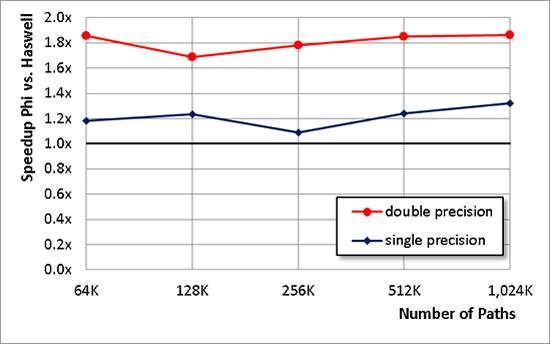
The Xeon Phi accelerator wins the race clearly for double precision, reaching around 1.8× speedup vs. the Haswell CPU. However, this drops to 1.2× in single precision. The main reason is that the single precision version requires only half the memory and hence makes better use of the cache. The Haswell CPU has more cache and a higher cache bandwidth, which decreases the performance advantage of the Xeon Phi.
While this is an overall win for the Xeon Phi, taking into account that typical servers are configured with two CPUs would reverse this result. Furthermore, a less than 2× performance improvement often doesn’t justify the move to a hardware accelerator in practice (i.e. Xeon Phi or GPUs). However, one should keep in mind that the key benefit of accelerator processors is that high-density server configurations can combine four or more accelerators. Combined with conventional CPUs and the right software, this can deliver quite spectacular performance.